

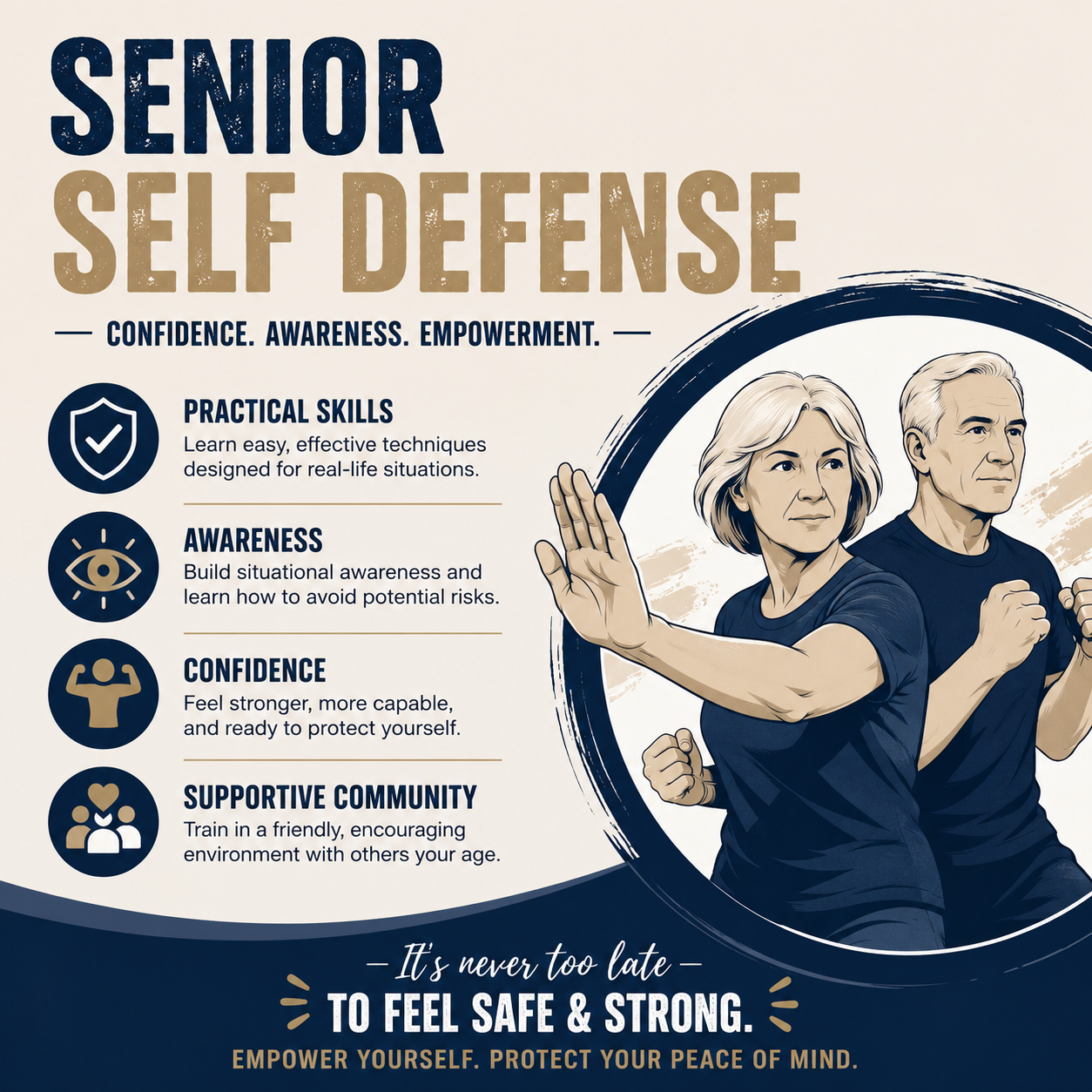
Senior Self-Defense & Personal Safety
Stay Independent. Stay Confident. Stay Prepared.
Getting older shouldn't mean giving up your independence—or your confidence.
At Apex Defensive Solutions, our Senior Self-Defense & Personal Safety training is designed specifically for older adults who want practical ways to become more aware, confident, and prepared in their everyday lives.
You don't need to be strong.
You don't need to be fast.
You don't need previous self-defense experience.
And you certainly don't need to become a fighter.
Our goal is to help you understand the options available to you and develop practical safety habits and skills that work with your individual abilities.
Self-Defense Starts Long Before a Physical Confrontation
For seniors especially, we believe some of the most valuable self-defense skills have nothing to do with throwing a punch.
Recognizing a potential problem early can give you more time and more options.
That's why our training places a strong emphasis on situational awareness, prevention, boundaries, communication, creating distance, and decision-making.
We discuss practical situations older adults may encounter while shopping, walking through parking lots, getting into and out of a vehicle, answering the door, interacting with strangers, traveling, or simply going about everyday life.
The objective isn't to make you afraid.
It's to make you better prepared.
Practical Training Designed Around You
Traditional self-defense techniques aren't always appropriate for every person.
Age, mobility, balance, previous injuries, joint issues, and other physical limitations can change what someone can comfortably and safely do.
We understand that.
Instead of expecting every student to perform the exact same technique, we focus on helping participants understand their individual options.
Training may include:
Situational awareness
Recognizing concerning behavior
Avoiding potentially dangerous situations
Verbal boundaries and confident communication
Creating and maintaining distance
Defensive positioning
Simple physical self-defense concepts
Escaping common grabs
Protecting yourself while creating an opportunity to get away
Using your surroundings to your advantage
Calling attention to a situation and getting help
Everyday personal-safety habits
Exercises can be modified whenever reasonably possible based on the abilities of the individual participant.
Your Voice Can Be a Self-Defense Tool
Self-defense isn't always physical.
Being willing to establish a boundary, confidently say NO, tell someone to back away, attract attention, or ask for help can be incredibly important.
Unfortunately, people sometimes take advantage of politeness.
You are allowed to establish boundaries.
You are allowed to leave.
You are allowed to ask for help.
And you don't owe a stranger access to your time, your personal information, your home, or your personal space simply because you don't want to appear rude.
We want our students to feel confident recognizing when something isn't right and taking action sooner rather than waiting for the situation to become worse.
Maintain Your Independence With Confidence
Many older adults value their independence tremendously.
Driving yourself to the store. Going out to eat. Attending church. Visiting friends. Traveling. Taking walks. Enjoying community events.
We don't want personal-safety concerns to stop you from doing those things.
Our philosophy is prepared, not paranoid.
Personal-safety training should give you more confidence to enjoy your independence—not make you afraid to leave your home.
The goal is to develop simple habits that become part of everyday life without consuming it.
You Are Not Expected to Overpower Someone
A realistic self-defense program shouldn't pretend that strength, size, age, and physical ability don't matter.
They do.
That's why we don't build our training around trying to outmuscle another person.
Instead, we focus on recognizing problems sooner, maintaining distance, making good decisions, using your voice, creating opportunities, and understanding what options may be available if someone does become physical.
There are no guarantees in self-defense.
But having more options is better than having none.
You Don't Have to Keep Up With Anyone
This isn't a competition.
There are no belts to earn, opponents to defeat, or athletic standards you need to meet.
You participate according to your abilities.
If you have difficulty getting on the ground, we don't need to put you on the ground.
If a movement doesn't work for you, we'll look at other options.
If you need to slow down, we slow down.
Our goal isn't to see what you can't do.
It's to help you discover what you can.
Personal Safety at Every Age
You are never too old to become more aware of your surroundings, establish stronger boundaries, learn something new, or become better prepared.
Whether you live independently, frequently travel, spend time out in the community, or simply want greater confidence in your ability to respond when something doesn't feel right, Apex is here to help.
You don't need to become a fighter.
You don't need to live afraid.
You simply need the knowledge, confidence, and practical options to become better prepared.
Stay Independent. Stay Confident. Stay Prepared.
Prepared People Are Harder to Victimize.
Senior Self-Defense & Personal Safety — FAQ
Am I too old to take a self-defense class?
No.
Personal safety isn't reserved for young, athletic people. Awareness, prevention, boundaries, communication, decision-making, and learning how to respond to an unsafe situation can be valuable at any age.
Our Senior Self-Defense & Personal Safety training is specifically designed with older adults in mind.
Do I have to get down on the floor?
No.
If getting onto the floor or back up again is difficult or unsafe for you, we aren't going to require you to do it.
Our training is adapted whenever reasonably possible to the abilities of the individual participant.
Do I need to be physically fit?
No.
You don't need to be strong, fast, flexible, or athletic to participate.
This isn't a fitness class or a competition. We focus on practical personal-safety concepts and options that can work with different ages and physical abilities.
What if I have bad knees, arthritis, balance problems, or another physical limitation?
Please let your instructor know before training.
We understand that many older adults have previous injuries, limited mobility, joint issues, balance concerns, or movements they simply shouldn't perform.
If something isn't appropriate for you, we'll work to modify the exercise or discuss another option whenever reasonably possible.
What if I use a cane or walker?
That doesn't automatically prevent you from participating.
Let us know about any mobility aids or limitations before class so we can help you participate safely and appropriately.
We want the training to work around your abilities—not expect you to work around the training.
Do I need any previous experience?
None at all.
You don't need martial arts, self-defense, or fighting experience.
Our classes are designed for everyday people, including complete beginners.
Is this a martial arts class?
No.
There are no belts, forms, tournaments, or competitions.
Apex focuses on practical personal safety and real-world self-defense.
Will I have to fight someone?
No.
You aren't going to be thrown into a fight with another student.
Some exercises may involve controlled physical contact, but training is supervised and adjusted appropriately for the participants.
What will I learn?
Training may include:
Situational awareness
Recognizing concerning behavior
Everyday safety habits
Verbal boundaries and confident communication
Creating and maintaining distance
Avoiding potentially dangerous situations
Simple defensive positioning
Escaping common grabs
Attracting attention and calling for help
Using your surroundings to your advantage
Creating opportunities to get away
Making decisions during stressful situations
Specific material may vary depending on the class.
Isn't self-defense mostly about fighting?
Not at Apex.
We believe some of the most important self-defense decisions happen before a situation becomes physical.
Recognizing a problem early, creating distance, setting a boundary, leaving an area, attracting attention, and asking for help may prevent you from ever needing to physically defend yourself.
What if someone is younger, bigger, or stronger than me?
Those differences matter, and we aren't going to pretend they don't.
Our training isn't based on trying to overpower someone.
Instead, we focus on awareness, distance, positioning, communication, practical techniques, creating opportunities, and getting to safety.
No self-defense technique comes with a guarantee, but training can give you more options than you had before.
Will I get hurt?
Safety is a priority during training.
Self-defense is physical, so some exercises may involve movement and controlled contact, but we aren't interested in unnecessarily pushing participants beyond their abilities.
Communicate with your instructor if something hurts, feels unsafe, or isn't appropriate for you.
What if I can't do one of the techniques?
That's okay.
Not every technique works equally well for every person.
If something doesn't work with your strength, mobility, balance, or physical abilities, we'll look at other options whenever possible.
Self-defense should adapt to the individual.
Will this class make me afraid to go places alone?
That's the opposite of what we want.
Our philosophy is prepared, not paranoid.
You should still go shopping, attend church, visit family, meet friends, travel, enjoy community events, and live your life.
We want personal-safety training to help you feel more confident in your independence, not afraid of it.
Can I bring my spouse or a friend?
Absolutely.
Training with a spouse, sibling, friend, neighbor, or other family member can make the experience even more enjoyable.
It also gives you someone to continue discussing and practicing safety concepts with after class.
Each participant will need to register.
What should I wear?
Wear comfortable clothing and supportive footwear that allow you to move safely.
You don't need special workout clothes. Choose something you feel comfortable moving around in.
What should I bring?
Bring water and anything specifically requested in your class information.
If you normally use a mobility aid, glasses, hearing aids, or another everyday device, you should generally train in a way that reflects how you actually live, provided it can be done safely.
Can a family member or caregiver attend with me?
Contact Apex before the class if you would like someone to accompany you.
We want participants to feel comfortable and will discuss what arrangements may be appropriate for the particular class.
Is this only for people who live alone?
Not at all.
Personal-safety skills can benefit older adults regardless of whether they live alone, with a spouse, with family, or in a senior community.
Will one class make me completely safe?
No.
No self-defense class can guarantee your safety or guarantee the outcome of a real confrontation.
Our goal is to improve your awareness, confidence, decision-making, and practical options so you're better prepared if something does go wrong.
What if I'm nervous about attending?
That's completely understandable, especially if you've never taken a self-defense class before.
You aren't expected to prove anything.
You aren't competing with anyone.
You don't have to keep up with the person beside you.
Come as you are, participate according to your abilities, and learn what you can do.
Still Have Questions?
If you're wondering whether you can participate because of your age, mobility, previous injuries, or another concern, contact Apex Defensive Solutions before registering.
We'd be happy to discuss the class with you and help determine whether it's appropriate for your individual needs.
You are never too old to become more aware, more confident, and better prepared.
Prepared People Are Harder to Victimize.